Martino Pedrozzi
Arch. dipl. epfl - fas/bsa
Via Noseda 20
CH–6850 Mendrisio
Switzerland
t +41 91 942 13 24
info@pedrozzi.com
Photos: Pino Brioschi, Alfio Tommasini, Simone Cavadini
Design: Gysin-Vanetti
Made in a limited series of 20 copies by the Werner Oechslin Library.
In the Egyptian pyramids, Greek columns or Breton menhirs the compression due to own weight is zero at the top and maximum at the base. The compression of the stone varies because, as the mass to be supported increases from top to bottom, it does not correspond proportionally to an increase in plan of the surface that supports it.
I perceive this as a static imperfection, a constructive compromise, a sizing defect. I ask myself then: is there a solid in which the average compression remains constant at any altitude?
The solution is an infinite height rotation solid described by a mathematical formula, in which is the constant proportion between the volume above any horizontal section and its area, the radius at height , and the base radius.
As an architect confronted with the force of gravity, I recognise in the geometric trunk that represents this solid an ideal form. I made this ideal shape out of bronze. Its internal compression is homogeneous and similar to the condition of a body suspended in a fluid of equal density, and produces the surprising sensation of a weightless mass.
Its particular property gives it character and personality. That is why I have called it Oi, the reflection of “io”, I in Italian language.


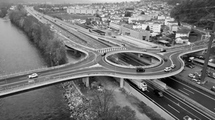
The elevated roundabout with a diameter of 60 metres resolves the junction within the motorway site and becomes a landmark of the new access to the city centre (architectural consultancy to Studio d’ingegneria Lurati Muttoni Parter).
The stage was conceived as a public space and an ephemeral performance structure. At the same time, it functioned symbolically, connecting the two banks of the river and reimagining the Cassarate as a connector in the Lugano plain rather than a border. This temporary construction site, created with students and assistants from the USI Academy of Architecture, was not only an educational exercise but also a civic gesture, developed in dialogue with local organisations and authorities.
Artistic and technical staging:
Noah Sartori, Associazione IDRA
City of Lugano representatives:
Karin Valenzano-Rossi, Nicoletta Crivelli
USI representatives:
Luisa Lambertini, Milan Savic
DECS representative:
Giorgio Robbiani
Cantonal Waterways Office representatives:
Andrea Salvetti, Giancarlo Moccetti
Structural and construction consulting:
Roberto Guidotti, Docente USI
Meteorological consulting:
Marco Gaia, MeteoSvizzera
Hydrological consulting:
Marco Tunesi, Studio Luigi Tunesi Ingegneria SA


| Realised projects | |
| 2026 | Pedestal for a meteorite |
| 2026 | Bridge between Visletto and Cevio (project with Studio d’ingegneria Lurati Muttoni Partner) |
| 2025 | Project “Un modello innovativo per Vacallo: vivere la terza età in un ambiente intergenerazionale” (with Vincenzo Tuccillo) |
| 2025 | Bellinzona motorway semi-junction (project with Studio d’ingegneria Lurati Muttoni Partner) |
| 2024 | Recomposition of two farmstead ruins in Val Piora, Leventina Valley (realised with USI students) |
| 2024 | Feasibility study on the Lüera area, Capolago Mendrisio |
| 2022 | Curating and setting up the exhibition “Il tratto e la parola. Schizzi originali di Oscar Niemeyer dalla collezione di Martino Pedrozzi”, USI, Academy of Architecture library (with Sidi Vanetti and Vincenzo Tuccillo) |
| 2022 | Levelling of Monte Rédond near the Trosa summit, Locarno region (realised with USI students) |
| 2021 | Levelling of a hump in Val di Sceru |
| 2021 | Exhibition set-up “Nakama, Aoi Huber Kono, Victoria Diaz Saravia”, Galleria Doppia V, Lugano |
| 2021 | Exhibition set-up “L’incanto del paesaggio”, Pinacoteca Züst, Rancate (with Sidi Vanetti) |
| 2020 | Restructuring of a house in Fosano |
| 2019 | Recomposition of Luzzone alp in Val Malvaglia (realised with USI, EPFL and ETHZ students) |
| 2018 | Deforestation in Sceru, Malvaglia Valley (realised with USI students) |
| 2017 | Dismanteling of a mountain farmstead in Sceru, Malvaglia Valley (realised with USI students) |
| 2017 | Restructuring of a farm in Fontanedo. Valle di Blenio |
| 2017 | Chapel in Val Malvaglia |
| 2016 | Recomposition of nine ruins in Quarnei, Malvaglia Valley (realised with USI students) |
| 2016 | Recomposition of a ruin in Semione |
| 2016 | New apartment in an early 20th century villa in Chiasso |
| 2015 | Recomposition of four ruins in Sceru, Malvaglia Valley |
| 2015 | Family tomb in Mendrisio |
| 2014 | Recomposition of Giumello alp, Malvaglia Valley |
| 2013 | Partial restructuring of a house in Solduno |
| 2013 | Restructuring of a house in Vacallo |
| 2013 | Recomposition of a ruin in Sceru, Malvaglia Valley |
| 2013 | Restructuring of a house in Bellinzona |
| 2013 | Restructuring of a house in Mendrisio |
| 2011 | Restructuring of a house in Pregassona |
| 2011 | Apartment house in Pregassona |
| 2010 | House in Pregassona |
| 2010 | Apartment house in Pregassona |
| 2010 | House in Sonvico |
| 2007 | Courtyard house restructuring in Pregassona |
| 2007 | Foot-bridge in Leontica (with Studio d’ingegneria Grignoli Muttoni Partner) |
| 2002 | Farmstead restoration in Sceru alp, Malvaglia |
| 2002 | Holiday home restructuring in Campo Vallemaggia |
| 2001 | Holiday home in Rima alp, Broglio |
| 2001 | Holiday home extension in Airolo |
| 2000 | Rcomposition of a ruin in Sceru alp, Malvaglia Valley |
| 2000 | Serravalle Castle lighting, Semione (with Pino Brioschi, photograph) |
| 1996 | Holiday home in Pizzada alp, Semione |
| 1994 | Holiday home in Sceru alp, Malvaglia |
| Unrealised projects | |
| 2024 | Monument in the cemetery of Fiesso, Leventina Valley |
| 2024 | Chapel in Malvaglia, Blenio Valley |
| 2019 | Urban requalification of Via Motta in Mendrisio |
| 2018 | Restructuring of a house in the historic core of Savosa |
| 2011 | House in Bellinzona |
| 2011 | Masterplan for a Neighbourhood of 200 social housing units in Dilijan, Armenia |
| 2009 | House in Bellinzona |
| 2008 | Apartment house in Caslano |
| 2006 | Foot-bridge in Locarno (with Studio d’ingegneria Grignoli Muttoni Partner) |
| 2005 | House in Mendrisio (with Victoria Diaz Saravia) |
| 2002 | Apartment building in Caslano |
| 2002 | Bridge in Pregassona (with Ingegneri Pedrazzini Guidotti) |
| 2002 | Farmhouse restructuring in Ligornetto |
| 2001 | Three houses in Semione |
| 1996 | Row houses in Semione |
| 1992 | Bow bridge, Swiss patent |
| Competition projects | |
| 2017 | Apartment house in Canobbio, restricted competition, 1st prize |
| 2016 | Set up of the Swiss pavilion for the Venice Architecture Biennale 2018 (with Sidi Vanetti) |
| 2016 | MALI Museo de Arte de Lima, new wing for contemporary art, Lima, Peru |
| 2015 | New ateliers at Mendrisio Academy of Architecture, restricted competition |
| 2015 | Foot-bridge "ex Ponte della Torretta" in Bellinzona (with Studio d’ingegneria Lurati Muttoni Partner) |
| 2015 | Apartments building in Lumino, restricted competition |
| 2014 | Bridge in Pollegio (with Marco Tajana, engineer) |
| 2014 | Foot-bridge on the Vedeggio river connecting Agno and Muzzano (with Marco Tajana, engineer) |
| 2014 | Bâloise group headquarters in Basel, restricted competition |
| 2013 | Multistorey parking and landscape design in Morat |
| 2013 | Library, classrooms and apartments for the Fondazione Torriani in Mendrisio (graphic consultant: Sidi Vanetti) |
| 2013 | Bellinzona main railway station renovation, restricted competition |
| 2012 | Secondary school building in Chiasso |
| 2012 | University of Applied Sciences in Mendrisio (with Kengo Kuma and Associates, Tokyo) |
| 2012 | Social housing building in Geneva |
| 2011 | Swiss Radio (RSI) building and site in Lugano-Besso, restricted competition |
| 2011 | Kindergarten in Lugano-Molino Nuovo (with Victoria Diaz Saravia) |
| 2011 | USI and SUPSI university campus, Lugano |
| 2010 | “Piazza stazione” and former motorway area project, restricted competition, Roveredo |
| 2010 | Studies for an Architecture Museum in Palazzo Turconi, Mendrisio |
| 2009 | Emergency Services Building in Mendrisio, 2nd phase |
| 2009 | Motorway semi-junction in Bellinzona, 1st prize (with Studi d’ingegneria Tajana & Partner and Edy Toscano) |
| 2008 | Park in Giubiasco, restricted competition |
| 2008 | New square in Pedrinate, restricted competition, 3rd prize |
| 2008 | Foot-bridge in Bellinzona (with Studio d’ingegneria Grignoli Muttoni Partner) |
| 2004 | Università della Svizzera italiana new faculty, Lugano |
| 2004 | New street paving, Arogno, restricted competition, 2nd prize |
| 2002 | Kindergarten in Comano |
| 2002 | Town multipurpose hall restructuring, Pregassona, restricted competition, 1st prize |
| 2002 | UBS bank restructuring in Mendrisio, call competition |
| 1999 | Cristallina mountain refuge, Bedretto |
| 1999 | Lakeside promenade, Ascona |
| 1998 | Nahuel Huapi National Park hotel in Patagonia, Argentina (with Giuditta Botta) |
| 1998 | Univesità della Svizzera Italiana Campus extension, Lugano |
| 1997 | Accademia di architettura extension, Mendrisio |
[…] it was a mass of stone, which any unknowing observer would have imagined was a heap of stone cast up by the permafrost. Two assistants, who removed the stones in three hours of enthusiastic work, uncovered some kind of centre and then a rectangular shape, eventually revealing the foundations of a farmhouse. Filled up with stones, they had taken on the shape of a grave. The picture which Loos supplies for his definition of architecture ("Someone was buried here, That is architecture.") focuses on the work of both assistants: here on the Sceru Alp they have buried a house. Let us imagine that these two continue tirelessly piling up stones to form graves which tell us about houses, barns and roads. That would be a beautiful way of confirming the rural exodus, wouldn’t it? This text–taken from the catalog of the exhibition “Neues Bauen in den Alpen, Architekturpreis 2006” in which my first recomposition in Sceru was exhibited–ends with the wish to see the work of recomposition begun on that alp continue. In the following years all the ruins of Sceru were recomposed as well as those of the Giumello alp. A few years later the recomposition of the Luzzone Alp was also completed, in which I involved the Section d’architecture of the EPFL, the Academy of Architecture of USI, the Institut für Landschaftsarchitektur of the ETHZ and their respective students, 120 in total. Two ruins in Val Piora were recomposed in 2024 with students from the USI Academy of Architecture.


Pizzada, Blenio Valley
New functions like sleeping, cooking, eating and resting are introduced into a mountain cowshed fallen into disuse. These functions, often considered partially incompatible in the same space, coexist around a fitted piece of furniture.


Sceru, Malvaglia Valley
A farmstead with dry stone walling has its eaves removed and has the woodwork normally visible between the sides walls and the roof covered. The resulting massive character contrasts sharply with the original tectonic design.


Courtyard house in Ligaino
A building consisting of parts built at different times set in a rural complex with a courtyard, takes on a harmonious contemporary character. The reconstruction process begins with the demolition of damaged parts like the wooden floors and woodwork. New floors are placed between existing load-bearing walls at different levels so as to permit direct horizontal and vertical movement, from one room to another, through apertures in the walls. The division into three similar floors in the original building is substituted by a set of independent rooms each placed at a specific level.


Apartment in Ligaino
On the top floor of a traditional house in the historic centre a cross shaped piece of furniture structures in four equivalent sectors the unitary space defined by the perimeter walls.


House in Sonvico
The one floor house leans on a slope and gets horizontality through two hollow pillars where secondary functions are placed.


Housing in Pregassona
The vertical structure composed by eight perimeter pillars and two central cores containing elevator and stairs is repeated without variations on all four floors. The access floor remains empty and row. On each of the remaining three floors the apartments are crossed by a diagonal space that emphasizes their major dimension and guarantees the access to all rooms.


House in Pregassona
A repetitive and close vertical structure, based on two inferior lateral bays and a main central one, allows reduced thicknesses for pillars (20x20 cm) and slabs (16 cm). The roof structure repeats the intermediate slab structure, but it is bent along its central axis.


House in Mendrisio
The house, located just outside the Mendrisio historic centre where once began the fields, has been absorbed over the years by the urban extension. However, its autonomy originally characterized by the agricultural context has paradoxically increased. After the creation of a built front along a recently realized road, the dwelling has found itself protagonist of a well defined space between the historical town edge and the new urban front. (with Victoria Diaz Saravia, facade graphic consultant: Sidi Vanetti)


The project was commissioned by the Armenian National Social Housing Association. It foresees the construction of 200 new housing units and the renovation of an existing building. The site is an area originally intended by initiative of the Moldovan state to the construction of residential blocks for homeless families after the 1988 Spitak earthquake. The initiative suffered a sudden interruption following the Soviet disintegration, leaving unfinished a series of terraces and a building. Our project originates from a careful analysis of these terraces that properly reshaped become the supporting surfaces of the new residential district. (Graphic consultant: Sidi Vanetti)


The chapel was built to replace and commemorate the old chapel of Ponte Cabbiera, which was submerged in the Val Malvaglia hydroelectric basin. Its location is characterized by the presence of a large boulder, present in the same position since before the construction of the dam. A place that has remained in its original state, not transformed by the excavation and terracing works, capable of giving the chapel a solid foundation with both a static and ideal profile. To those coming by car from the valley, the chapel appears at the bottom of a straight line whose axis is aligned with the cross. The spatial relationship with the road, a modern expression of the ancient paths of the valley, links the chapel to a wider landscape context. The chapel has been imagined as a light raw iron structure composed of a roof obtained by welding two 15 millimetre sheets along the ridge, and six columns 65 millimetres in diameter stuck to the rock by mean of core drilling. The roof is simply supported and maintains its position thanks to its own weight and six pins placed at the top of the columns. A path climbs up from the road, crosses a hazelnut forest and ends up above the chapel in a flat area where a mass is celebrated annually.


Gaining a horizontal plane in wild nature is a founding architectural moment. It is via this so very rational – and so very human – act that human beings assert their otherness and identify as living beings. This work seeks to reforge this original bond with the land and with the prospect of altering it.
In the first intervention, carried out in 2021, the top of a hump emerging from the bottom of the Sceru Valley, at an altitude of 2,211 metres, was levelled. The following year, with the involvement of 24 students from the USI Academy of Architecture and their assistants, the Redónd, a summit adjacent to the Trosa, was levelled, defining a perfectly flat plane of approximately 7×22 metres.
Such radical actions, almost an anticipation of a multi-millennial erosion process, bring to light long-buried rocks, which, emerging from this new reference height, become the unexpected and unpredictable expression of a surreal landscape.


In Sceru, a small shelter built who knows when was very close to collapse. The dry-stone walls were hanging down; the roof stones were untidy and incomplete; the truss, exposed to the rain, was crumbling. Impossible to restore, senseless to rebuild. Involving students and assistants from my design course at the USI Academy of Architecture, the building was dismantled and its pieces stored inside, like a Meccano box.


The abandoning of the alpine pastures in Valle Malvaglia did not only have consequences on the built heritage. The very landscape underwent a continuous transformation characterised by the woods encroaching on the clearings and their upper limit rising well above 2000 metres asl. In the recent decades of abandonment, the pasture, cultivation and mowing areas in disuse have gradually rewilded, blurring the reading of the collective, if not public, spaces once given over to farming production. The larch trees on the Alpe di Scéru were beginning to touch buildings originally standing in open spaces and above the upper growth limit of the woods. The work, which involved students and assistants from my design course at the USI Academy of Architecture, was a restoration of the landscape. By removing the vegetation, consisting mainly of a homogenous young larch forest, from a certain height downwards, new clarity was restored to the reading of this man-made landscape, while at the same time favouring the biodiversity of the site.


Row of trees
The project stems from an old mountain trail linked to transhumance in the Scéru Alps, in Val Malvaglia, which no longer appears in the official trail network. Its discovery provides an opportunity to carry out an action that has the strength and intensity of a founding act: thirteen larch trees, purchased from the cantonal nursery, are planted at regular intervals to define a straight line of seventy metres which, longitudinally, reaffirms the presence of this forgotten path and, transversally, becomes a reference and measurement system for the landscape itself. An intentional, artificial sign that enables a new reading of this natural space and generates new relationships within the context. An intervention carried out with students from the USI Academy of Architecture that forces us to confront and reason with the long timescales of nature: planting small trees today and waiting patiently, perhaps twenty years, for the expected spatial effect to be fully realised and configure a new landscape.


Pavilions
This project is the result of a collective design workshop organised as part of my design course at the USI Academy of Architecture. Over four days of work, three pavilions were designed and then built by the students themselves in the Ongaro quarry in Cresciano to provide protection from the sun and rain for the quarry workers. The intrinsic monumentality of the Cresciano quarry, accessible via an evocative ascending path reminiscent of that leading to the Temple of Apollo at Delphi, became the exceptional setting for these three “small temples”, built by hand using only logs and threaded bars, in an intentional syntactic reduction of the construction process.


Playground
The opportunity for intervention arose from the desire of the municipality of Arogno to improve the spatial quality of the school complex. The proposal was to create a playground that would reflect, in an educational sense, on the value of such a space: during a four-day collective workshop with my students and assistants from the USI Academy of Architecture, a children’s playground was conceived and developed in detail, where the games – not limited to a single, immediate meaning – could become spatial installations capable of activating the space and promoting original interactions with it. There are four characteristic elements of this new landscape to be explored, made entirely of construction fir: a stage, symbolising openness and expression; a patio, which houses a pre-existing palm tree and turns it into a secluded “exotic” retreat; a pier that measures the existing topography; and a tower with a cowbell that rings in the wind. The construction phase was enriched by moments of interaction with the children, the future users of this space.


Section on Lake Ceresio
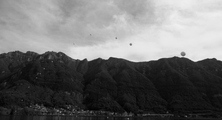
The fine line between the visible and the invisible is a defining feature of our experience of the natural landscape. Our everyday perception of natural phenomena is mostly linked to their immediate and apparent expression and is often unaware – unless we deliberately seek deeper understanding – of the causes of certain events, or of what lies beyond the limits of the visible. This condition gives rise to a sense of mystery, fascination and reverence for nature, which is why, often, intervening in nature in a cognitive sense can translate into the act of “revealing” one of its hidden characteristics, lifting the veil of the invisible for a moment in order to offer a new perception of everyday life. The work, carried out with my students at the USI Academy of Architecture, set out to do just that, starting with one of the elements that most strongly characterises the landscape and imagery of Ticino, namely Lake Ceresio: near the mouth of the Sovaglia river, where Lake Ceresio reaches its minimum width, 13 balloons attached by ropes to buoys spaced at regular intervals of about 40 metres were raised into the sky to a height that exactly replicated the depth of the lake at that point. A section of Lake Ceresio was thus turned upside down in the sky for a few days, revealing to everyone the unexpected profile of its depths.
Raft
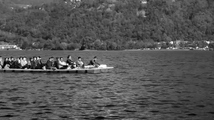
The project, designed with the help of engineer Roberto Guidotti, involved my students at the USI Academy of Architecture building a 3×10 metre raft on a 1:1 scale, which was used for a short trip on Lake Ceresio. A mobile platform floating in the middle of the lake became an unexpected teaching tool that combined playfulness with calculated transgression. The project, specific to its use and context, where the assembly of the planks was designed to ensure flexibility and thus the absorption of wave motion, offered all passengers an absolute spatial experience.
Basler Versicherungen Hauptsitz
Der architektonische Ausdruck des Basler Versicherungen Hauptsitz entsteht durch technische Anforderungen und eine präzise architektonische Vorstellung: einerseits muss ein hoher thermischer Standard erfüllt werden, welcher eine lückenlos gedämmte Hülle fordert, andererseits besteht der Anspruch auf eine Fassade, die nicht eine Verkleidung oder eine nachträglich angebrachte Oberfläche ist. Der öffentliche Ausdruck des Gebäudes besteht aus einem monolithischem Flachrelief. Die Mauern, wie nebeneinanderstehende Scheiben, sind unabhängige Elemente, distanziert vom eigentlichen Baukörper und durch eine Serie von horizontalen, in der Fassade mit Bolzen an das sich dahinter befindende Gebäude befestigt. Diese Bolzen definieren, zusammen mit Versteifungsrippen, den Rhythmus der Fassade. (Wettbewerb auf Einladung)


Mendrisio Academy of Architecture design studio spaces
In the project for the Mendrisio Academy of Architecture design studio spaces a new platform supports the new volume, that together with the three existing buildings defines a public space. Its four facades are made of cast on site monolithic reinforced concrete 12cm thick. They are self-supporting and separated along the vertical edges. Their autonomy, two-dimensionality and frontality express in a precise way the ultimate purpose of a facade: to represent the building, similarly to a mask.


Bellinzona railway Station
The Bellinzona railway Station is located on a artificial platform. On this platform, arrival surface to the city for those who arrive by train, the two historic buildings emerge with autonomy once demolished the newest and of less value elements. Our new building, a loggia, is a structure that covers the transitional space between travel and destination, between train and city. The loggia is the city threshold. (Competition by invitation)


Logements à Genève
L’immeuble de logements à Genève est conçu comme un bloc planté dans la végétation avec deux grandes arrière-plans verts au nord et à l’ouest. Au bloc compact, composé d’éléments préfabriqués en béton, se juxtapose, presque sans le toucher, une fine structure composée de piliers et dalles qui dessine d’un trait fin mais décidé le volume d’une grande galerie sur plusieurs étages. C’est la tension entre ces deux objets, le mince vide qui les sépare, qui représente l’un des thèmes clés du projet. Les galeries superposées évoquent un grand scénario où les gens se mettent sur scène.


Venezia Biennale
With our project we propose a reflection on the notion of limit, understood as artificial spatial separation. We do this by redefining the reciprocal spatial relations between pavilion, gardens and city. By means of a new wall we move the entrance of the pavilion outside the Giardini fence. This intervention overturns the spatial condition that accumulates all the national pavilions, characterized by the inclusion within a closed exhibition perimeter. The Swiss pavilion is located outside the fence, in direct contact with the public space of Venice. The gesture is overbearing because it prevents habitual access to the exhibition spaces and excludes them from the pavilion community. But at the same time it is a gesture of maximum openness: these spaces, which in the context of the Biennale represent Switzerland, become accessible to everyone. We do not want to give a univocal interpretation of our proposal or convey a defined message. We prefer the idea of provoking visitors emotionally through an installation that suggests sensations such as inclusion and exclusion, rejection and welcome or spatial closure and openness. The entrance is therefore free, along an ideal path connected to every square, bank or calle of Venice. The public walks along an urban promenade that creeps into the pavilion, crosses its deliberately bare spaces and culminates in the main hall where the large painting of a vast alpine landscape stands out.
With Sidi Vanetti.


The gravitational pull of the Earth on the meteorite is identical to that exerted by the meteorite on the Earth. The meteorite and the Earth attract each other equally, according to Newton’s law of universal gravitation. The pedestal, consisting of a polypropylene cushion filled with helium, neutralises the force of gravity to which it is subjected thanks to its aerostatic nature. The only forces to which it is subjected are those of mutual attraction between the Earth and the meteorite, which compress it symmetrically on both sides.


| Essere felici (documentary by Vasco Dones and Franco Cattaneo, 2020) |
| 2017 | Umsicht-Regards-Sguardi, four-year SIA (Swiss Society of Engineers and Architects) award, mention: Recompositions in Sceru and Giumello in Val Malvaglia |
| 2016 | Arc-award, Jury special prize: Recompositions in Sceru and Giumello in Val Malvaglia |
| 2016 | Swiss art awards 2016, finalist: recompositions in Sceru and Giumello in Malvaglia Valley |
| 2016 | SIA-Ticino Award for the best buildings in Ticino from 2012 to 2016, mention: recompositions in Sceru and Giumello in Malvaglia Valley |
| 2015 | Die Besten 2015 Award for the best buildings in Switzerland in 2015, mention: recompositions in Sceru and Giumello in Malvaglia Valley |
| 2008 | Die Besten 2008 Award for the best buildings in Switzerland in 2008: courtyard house restructuring in Pregassona (in 2009 a member of the awarding jury) |
| 2007 | SIA-Ticino Award for the best private building in Ticino from 2004 to 2007: courtyard house restructuring in Pregassona |
| 2006 | New alpine architecture, international architecture prize, Sesto Cultura: restoration of a farmhouse and a ruined farmhouse in Sceru alp, Malvaglia |
| 1999 | New alpine architecture, international architecture prize, Sesto Cultura: holiday house in Pizzada alp, Semione |
| Books | |
| 2025 | Martino Pedrozzi, “Referent or pretext”, in Michael Jakob (edited by), Pino Musi Continuum, coedited by Mendrisio Academy Press and Silvana Editoriale |
| 2025 | Nicola Navone “L’architettura delle cappelle votive nel Ticino del XX secolo: una prima ricognizione”; in Andrea a Marca, Francesca Luisoni e Paolo Ostinelli (edited by); Sguardi divini, Cappelle e dipinti murali devozionali del Sopraceneri; Repubblica e Cantone Ticino, Centro di dialettologia e di etnografia |
| 2025 | Francesca Chiorino “Ricomposizioni. Il ripristino dello spazio pubblico alpino”, in Francesca Chiorino and Marco Mulazzani (edited by), Ritorno alle Alpi. Architetture della responsabilità, Quaderni della Fondazione Courmayeur Mont Blanc no. 50, Musmeci Editore |
| 2023 | Mario Botta, “Martino Pedrozzi, Cappella del ponte Cabbiera, Serravalle, 2019”, in Mario Botta, Il cielo in terra, Milan, Libri Scheiwiller |
| 2023 | Matteo Iannello, “Memoria, territorio e comunità nel Canton Ticino: interventi sull’architettura rurale in Val di Blenio e Val Malvaglia”, in Valter Curzi (edited by), Musei e patrimonio culturale. Forme di narrazione della contemporaneità, Milan, Skira |
| 2017 | “Ornamenti is crime”, Phaidon |
| 2015 | Ticino Guide, Architettura e ingegneria, Canton Ticino 2000-2015, Archi, Verlags AG, Zurich |
| 2008 | Neues Bauen in den Alpen, architekturpreis 2006, Sexten Kultur, Birkhäuser Verlag, isbn 978-3-7643-8394-7 |
| 2000 | Neues Bauen in den Alpen, architekturpreis 1999, Sexten Kultur, Birkhäuser Verlag, isbn 3-7643-6115-8 |
| Magazines | |
| 2025 | Dieter Geissbühlen and Felix Wettstein, «Reaktionen», Portal, no. 61 |
| 2025 | Andrea Muheim and Hartmut Nägele, «Architektur Fotografie», Archithese, no. 1 |
| 2024 | Carlo Ezechieli, “Tre interventi di Martino Pedrozzi nelle valli del Canton Ticino”, IoArch, 109 |
| 2023 | Nicola Navone, “Un oratorio e una cappella in Ticino”, Archalp, no. 11 |
| 2023 | Roberto Dini, “Tra memoria e progetto. Alla ricerca di nuovi significati per l’architettura alpina”, Archi, no. 6 |
| 2022 | Antonio De Rossi, “Architettura e ambiente, una relazione complessa e mobile”, Archalp, no. 9 |
| 2022 | Federico Tranfa, review of “Cigarrilhas, Dois meses no escritório de Oscar Niemeyer”, Casabella 939 |
| 2021 | Daria Farafonova, “Costruire la città. Conversazione con Mario Botta”, Filigrane. Culture letterarie, no. 1 |
| 2021 | Claudia Schwalfenberg, “Gemeinden und Städte baukulturell beraten – aber wie?”, TEC21, no. 7 |
| 2021 | Mauro Marinelli, “Terra! L’agricoltura come pratica di architettura”, a, no. 3 |
| 2019 | “ARCHALP”, no 02 |
| 2018 | “ARCHALP”, no 01 |
| 2018 | “FACES, Journal d’architecture”, no.74 |
| 2018 | “Archithese”, Jun-Aug 2 |
| 2017 | “Phoenix, Bauen im Bestand”, no. 11, BL Verlag AG, Schlieren |
| 2017 | “100 Ferien Hauser”, 100 Medien GmbH, Ammerndorf, Germania |
| 2017 | “Viso, Schweizer Baudokumentation”, no. 4 2017, Rüschlikon |
| 2017 | “Modulor”, No.3 2017, NZZ Fachmedien AG, Urdorf |
| 2016 | “Archi”, no. 4, Lugano |
| 2016 | Catalogue of Premio SIA Ticino 2016 award |
| 2015 | Architecture Suisse, 199-1 |
| 2015 | Hochparterre, no.12, Zurich |
| 2015 | Werk, bauen+wohnen, no.3, Zurich |
| 2015 | Hochparterre Wettbewerbe, no. 1, Zurich |
| 2014 | Ticino Management, no. 4, Lugano |
| 2014 | Square, USI-magasine, no. 14, Lugano |
| 2013 | Viso, Schweizer Baudokumentation , no. 5, Rüschlikon |
| 2013 | Umbauen+Renovieren, no. 6, Zurich |
| 2013 | Das Ideale Heim, no. 6, Zurich |
| 2013 | Ticino Management, no. 4, Lugano |
| 2013 | Archi, no. 6, Lugano |
| 2013 | Faces, Journal d’architecture, no.72, Geneva |
| 2012 | Hochparterre, no. 5, Zurich |
| 2012 | Traumhaus, no. 5, Schlieren |
| 2012 | Talea, no. 31, Como |
| 2012 | Ticinosette, no. 35, Muzzano |
| 2011 | Werk, bauen+wohnen, no.11, Zurich |
| 2008 | Domus, Russian Edition, no.9, Moscow |
| 2008 | Domus, no.914, Milan |
| 2008 | Werk, bauen+wohnen, no.9, Zurich |
| 2008 | Architecture today, no.186, London |
| 2008 | Hockparterre, no.12, Zurigo |
| 2007 | Piso, ciudad al ras, no.11, Guadalajara |
| 2007 | Architecture Suisse, no.167, Lausanne |
| 2007 | Premio SIA Ticino 2007, Edizioni Casagrande, Bellinzona |
| 2006 | Hochparterre, beilage, no.10, Zurich |
| 2006 | Time+Architecture, no.5, Shanghai |
| 2005 | Piso, ciudad al ras, no.7, Guadalajara |
| 2000 | JA, the japan architect, no.36, winter 2000, Tokyo |
| 1999 | Shinkenchiku: 1999, no.12, Bunkyo-Ku, Tokyo 113-8501 |
| Digital | |
| 2024 | Aline Stadler, “Sichtbarmachung alter Tessiner Alpweiden: Stallruinen und architektonische Interventionen”, Syntopia Alpina, www.syntopia-alpina.ch |
| 2021 | Daria Farafonova, “Costruire la città. Daria Farafonova in dialogo con Mario Botta”, Le parole e le cose, www.leparoleelecose.it |
| 2021 | Michael Jakob, “Ricomporre pietre”, Doppiozero, www.doppiozero.com |
| 2020 | frizzifrizzi.it, “Primavera 2020, un docente offre in dono ai suoi studenti le note e gli spunti dai suoi libri più preziosi” |
| 2020 | Espazium, Stefano Moor on Martino Pedrozzi, “Casa a Sonvico” |
| 2017 | “Transfer, Global Architecture Platform”, www.transfer-arch.com |
| 2016 | Le Temps, blog by Philippe Meier, ”Les pierres sauvées” |
| 2002 | Architetture nel territorio, Canton Ticino 1970-2000, CD-ROM, Authors: Mercedes Daguerre e Graziella Zannone Milan, Edizioni Tarmac, Mendrisio |
| Exhibitions | |
| 2025 | Exhibition “Montañas y pliegues. Observaciones a partir de una botella Moche”, MALI Museo de Arte de Lima, Perù |
| 2025 | 14th São Paulo International Architecture Biennale, Brazil |
| 2024 | Exhibition “Premio di architettura Vionelab”, Comunità montana di Valle Camonica |
| 2023 | Exhibition “L’abric de les ruïnes”, Centre de Cultura i Memòria, Barcelona, Spain |
| 2019 | Exhibition “Mountains and the rise of Landscape”, Harvard GSD, Cambridge USA |
| 2017 | Exhibition and catalogue “Umsicht, Regards, Sguardi 2017”, SIA Svizzera |
| 2016 | Exhibition “5 architetti del Canton Ticino”, Festa dell’architettura 2016. Forlí, Italia |
| 2016 | Exhibition and catalogue “Schweizweit”, Schweizerisches Architekturmuseum, Basilea |
| 2016 | Exhibition and catalogue “Arc-award 2016”, Zurigo |
| 2016 | Exhibition “Arquitectura militante en Ticino”, Colegio Federado de Ingenieros y Arquitectos, San José, Costa Rica |
| 2012 | Exhibition and catalogue Import Ticino, Barcelona |
| 2009 | Exhibition Architecture through pictures, SCI-Arc European Program, Vico Morcote, introduced by Bruno Reichlin |
| Press | |
| 2021 | Laura Di Corcia, “Ricostruire i ricordi”, Azione, 2 Aug. |
| 2021 | Attilio D’Andrea and Annegret Diethelm, “Martino Pedrozzi, Aufräumen wider das Vergessen”, Tessiner Zeitung, 29 Jan. |
| 2019 | Corriere del Ticino, 21 Mar. |
| 2019 | Voce di Blenio, Mar. |
| 2017 | AZIONE, “L’arte di riordinare le pietre”, 21 Aug. |
| 2016 | Voce di Blenio, Oct. |
| 2016 | Corriere del Ticino, 23 Jul. |
| 2016 | La Regione, 18 Jul. |
| 2016 | La Regione, 2 Mar. |
| 2016 | Corriere del Ticino, 5 Mar. |
| 2015 | Voce di Blenio, “Ricomposizioni in Val Malvaglia, Oct. |
| TV and radio | |
| 2022 | Daniel Bilenko, “I tratti, le parole e i cigarillos di Oscar Niemeyer”, RSI, Rete 2, Diderot, 8 Jul. |
| 2021 | V. Dones and F. Cattaneo, “Essere felici” (documentary on the recomposition of Alpe Luzzone by Martino Pedrozzi with 120 architecture students from USI, EPFL and ETH), RSI, LA2, Storie, 29 Aug. |
| 2017 | RSI, Rete due, Attualità culturale, “Ricomposizioni di pietra, by Daniel Bilenko |
| 2016 | RSI television report, Il Quotidiano, 31 Aug. |
| 2016 | RSI, Rete due, Attualità culturale, “Ricomporre le pietre”, by Lina Simoneschi, 4 Jul. |
| 2010 | Cronache della Svizzera Italiana, Radio della Svizzera Italiana, Vladimir Sapozhnikov correspondence from Moskow Biennial |
| 2010 | I luoghi dell’anima, interview at the Radio della Svizzera Italiana on the courtyard house restructuring in Pregassona |
| 2009 | Foglio volante, interview at the Radio della Svizzera Italiana on Architecture through pictures exhibition in Vico Morcote |
| 2008 | Il Quotidiano, TV report on the Televisione della Svizzera Italiana on the new motorway junction in Bellinzona |
| 2008 | Kulturplatz, TV report on the Schweizer Fernsehen on Die Bestem 08 Award |
| 2007 | Buonasera, TV report on the Televisione della Svizzera Italiana on the SIA Award |
| Lectures | |
| 2026 | Sapienza Università di Roma |
| 2025 | Swiss Institute, Venice (from minute 40:45) |
| 2025 | 14th São Paulo International Architecture Biennale, Brazil |
| 2024 | Letteraltura Festival, Verbania, Italy |
| 2024 | Trento University, Italy |
| 2023 | Fondazione Courmayeur, Aosta, Italy |
| 2023 | Speech within the framework of the 60th anniversary of Swiss-Korean diplomatic relations, Swiss Embassy in Seoul, (remote lecture) |
| 2023 | Escola da Cidade, Sao Paulo, Brazil |
| 2023 | FAUUSP, Sao Paulo, Brazil |
| 2023 | SUPSI, Department of Environment Constructions and Design |
| 2023 | Trentino School of Management, Trento, Italy (remote lecture) |
| 2021 | Cima Norma Art Festival, Dangio, Blenio Valley |
| 2020 | Academy of Architecture, Università della Svizzera italiana, “Architettura diretta. Pratica e didattica dell’esperienza” |
| 2019 | ENSASE, École Nationale Supérieure d’Architecture de Saint-Étienne, France |
| 2019 | ENSAPVS, École Nationale Supérieure d’Architecture Paris Val de Seine, France |
| 2019 | Ordine architetti Varese, Villa Panza, Italy |
| 2018 | University of Belgrade, Faculty of Architecture, Serbia |
| 2018 | Open House Basel |
| 2018 | HEPIA, Haute école du paysage, d’ingénierie et d’architecture de Genève |
| 2018 | Lecture series “Costruire territori”, Premadio Valdidentro, Italy |
| 2018 | Architektur Salon, Hamburg |
| 2018 | Forum d’architectures, Lausanne |
| 2018 | BSA Zentralschweiz, Lucerne |
| 2017 | Casabella Formazione, Milan |
| 2016 | Colegio Federado de Ingenieros y Arquitectos de Costa Rica, San José, Costa Rica |
| 2016 | Festa dell’Architettura, Forlì, Italy |
| 2016 | Opening of the exhibition “Import Ticino – Architecture and Territory”. Collegi d’arquitectes, Tarragona, Spain |
| 2016 | ENSAN, École Nationale Supérieure d’Architecture Nancy, France |
| 2016 | ENSASE, École Nationale Supérieure d’Architecture de Saint-Étienne, France |
| 2014 | Università degli Studi, Pavia, Italy |
| 2013 | 20. International design workshop, Monte Carasso, Switzerland |
| 2011 | Escola da Cidade, São Paulo, Brazil |
| 2010 | Biennale of architecture, Moscow |
| 2007 | United Arab Emirates University, Al Ain, United Arab Emirates |
| 2007 | Haute école d’art et de design, Geneva, Switzerland |
| 2007 | Università degli studi of Genua, Italy |
| Lectures in the frame of WISH | |
| 2025 | Mongolian University of Science and Technology, Ulaanbaatar, Mongolia |
| 2024 | Universidade Federal do Amazonas, Manaus, Brazil |
| 2023 | Tashkent University of Architecture and Civil Engineering, Uzbekistan |
| 2021 | Longyearbyen Municipal Library, Svalbard Islands, Norway |
| 2017 | Pontificia Universidad Javeriana, Bogotá, Colombia |
| 2016 | CUJAE, Instituto Superior Politécnico José Antonio Echeverría, La Habana, Cuba |
| 2015 | Arcadia Mediatica, Lima, Peru |
| 2014 | Masayuki Kurokawa Office, Tokyo |
| 2011 | Faculdade de Arquitetura e Urbanismo, Universidade de São Paulo, FAU-USP, Brazil |
| 2010 | CEPT University, Ahmedabad, India |
| 2006 | University of the Witwatersrand, Johannesburg, South Africa |
| 2005 | Graduate School of Architecture, Nanjing Univerity, Nanjing, China |
| 2004 | Universidad Autonoma de Baja California, Mexicali, Mexico |
| 2003 | College of Architects of the city of Tucumán, Argentina |
| Conferences | |
| 2025 | Book presentation of “Constructed Geographies: Paulo Mendes da Rocha”, with Vanessa Grossman, Solano Benitez, Ciro Miguel, Annette Spiro e Ana Pinto, Seminario Internazionale di Monte Carasso, 18 Jul. |
| 2024 | MEM, Middle East Mediterranean Summit, Lugano, 6 nov. |
| 2023 | “Arquitetura reta”, debate with Angelo Bucci and Guilherme Wisnik, FAUUSP, Sao Paulo, Brazil, 14 Jun. |
| 2023 | Book presentation of “Cigarrilhas, Dois meses no escritório de Oscar Niemeyer”, with Angelo Bucci and Alvaro Puntoni, FAUUSP, San Paolo, Brasile, 13 Jun. |
| 2023 | Book presentation “The House at Capo d’Orso”, MIT Press 2023, with author Sebastiano Brandolini and Thomas Weaver, Libreria Spazio, Milan, 9 Jun. |
| 2022 | Presentation of the book “Cigarrilhas, Dois meses no escritório de Oscar Niemeyer”, with Matteo Terzaghi, Academy of Architecture library, 18 Oct. |
| 2021 | Martino Pedrozzi, “The new ponte Cabbiera chapel in Val Malvaglia”, Conceptual design symposium, Fédération Internationale du Béton, Attisholz Areal, Solothurn, 16 Sep. |
| 2019 | Panel discussion Harvard GSD, Graduate School of Design, Cambridge USA |
| 2017 | Roundtable SAM (Schweizerisches Architekturmuseum) Basel |
| 2016 | Swiss Architects Federation general assembly, Geneva |
| 2007 | Brasilea Foundation, Basel, Switzerland, roundtable with Annette Spiro and Meinrad Morger for Oscar Niemeyer’s 100th anniversary |
| Diploma studio professor | ||
| 2026 | Spring semester | Ticino. Side views |
| 2025 | Spring semester | Lisbon southern shore, the estuary at the centre |
| 2024 | Spring semester | Basel 2035, a city of research, industry and culture |
| Studio professor | ||
| 2025 | SA Bachelor III and Master | Lugano. Unfolding the river |
| 2024 | SA Bachelor III and Master | Quinto. Alpine perspectives |
| 2023 | SA Bachelor III and Master | Val Mara. Questioning reality |
| 2022 | SA Bachelor III and Master | Locarno. Groundworks |
| 2020 | SA Bachelor III | Foundation gesture |
| 2020 | SP Bachelor III and Master | A space for leisure |
| 2019 | SA Bachelor III and Master | Constructing space |
| 2019 | SP Bachelor II | Abitare in pietra a Ballraó |
| 2018 | SA Bachelor II | Abbattere, erigere |
| 2018 | SP Bachelor II | Lugano, Casualità e disegno |
| 2017 | SA Bachelor II | Scomporre, comporre architettura |
| 2016 | SA Bachelor III and Master | Mutazioni: Quarnei e Novi Beograd |
| Thesis expert | |
| 2011 | SUPSI-DACD |
| 2010 | Prof. Marco Bakker, FH Bern |
| 2007 | Prof. Bruno Marchand, EPFL |
| Invited lecturer | |
| 2024 | Course Prof. Sascha Rösler, The city as energy landscape, USI Academy of Architecture, Mendrisio |
| 2024 | Course Prof. Momoyo Kaijima and Prof. Laurent Stalder, ETH D-ARCH |
| 2024 | Course Lecturer Felix Wettstein, Hochschule Luzern, Technik und Architektur |
| 2022 | Course Prof. Nicola Braghieri, EPFL |
| 2022 | Course Lecturers Cristiana Lopes e Giacomo Brenna, USI Academy of Architecture, Mendrisio |
| 2021 | Course Prof. Riccardo Blumer, USI Academy of Architecture, Mendrisio |
| 2021 | Course Prof. Michael Jakob, Politecnico di Milano |
| 2021 | Course Prof. Sascha Rösler, The city as energy landscape, seminar and public lecture series, USI Academy of Architecture, Mendrisio |
| 2018 | Course Prof. Muck Petzet, USI Academy of Architecture, Mendrisio |
| 2016 | Design studio Nicola Baserga, USI Academy of Architecture, Mendrisio |
| 2016 | Design studio Stefano Moor, University of Applied Sciences, Geneva |
| 2015 | Design studio Paolo Canevascini, USI Academy of Architecture, Mendrisio |
| Invited critic | |
| 2025 | Design studio Prof. João Nuñes e Prof. João Gomes da Silva, USI Academy of Architecture, Mendrisio |
| 2024 | Design studio Prof. Eva Prats, USI Academy of Architecture, Mendrisio |
| 2023 | Design studio Prof. Eva Prats, USI Academy of Architecture, Mendrisio |
| 2023 | Design studio Lecturer Giuliano Gavin, SUPSI-DACD |
| 2022 | Design studio Prof. Carla Juaçaba, USI Academy of Architecture, Mendrisio |
| 2021 | Design studio Prof. Giacomo Guidotti, Haute école d’ingénierie et d’architecture Fribourg |
| 2021 | Design studio Lecturer Felix Wettstein, Hochschule Luzern, Technik und Architektur |
| 2019 | Discussion with Prof. Paolo Amaldi Phd students, École Nationale Supérieure d’Architecture Paris Val de Seine |
| 2019 | Design studio Lucien Colin and Mario Ferrari, École Nationale Supérieure d’Architecture de Nancy |
| 2019 | Design studio Paolo Canevascini, USI Academy of Architecture, Mendrisio |
| 2016 | Design studio Andrea Pedrazzini, École Nationale Supérieure d’Architecture de Saint-Étienne |
| 2016 | Design studio Nicola Baserga, USI Academy of Architecture, Mendrisio |
| 2016 | Design studio Stefano Moor, HES Geneva |
| 2015 | Design studio Giacomo Guidotti, HES Friburg |
| 2014 | Design studio Francis Kéré, USI Academy of Architecture, Mendrisio |
| 2013 | Design studio Angelo Bucci, ETHZ |
| 2009 | Diploma design studio Jonathan Sergison, USI Academy of Architecture, Mendrisio |
| 2009 | Design studio Lukas Meyer, SUPSI |
| 2008 | Design studio Ludovica Molo, SCI-Arc, Vico Morcote |
| 2008 | Design studio Jonathan Woolf, USI Academy of Architecture, Mendrisio |
| 2007 | Design studio Sebastiano Brandolini and Alfonso Femia, Kent State University, Floence |
| 2001 | Design studio Kenneth Frampton, USI Academy of Architecture, Mendrisio |
| 2000 | Design studio Vincent Mangeat, EPFL |
WISH, an acronym for Workshop on International Social Housing, is an annual USI Academy of Architecture design course that was created with the specific intent of addressing and investigating, through architectural design, the theme of collective and social housing. The course has a profound international vocation and tries to establish with interested countries and institutions, a fruitful academic collaboration.
www.wish.usi.ch
| City | Topic | Partner | |
| 2026 | Black River, Jamaica | Reacting the natural disaster | University of Technology, Jamaica |
| 2025 | Ulaanbaatar, Mongolia | Internal migration | Mongolian University of Science and Technology |
| 2024 | Manaus, Brazil | Rethinking the relationship between rainforest and city | Universidade Federal do Amazonas |
| 2023 | Bukhara, Uzbekistan | Transforming the legacy of Soviet urbanisation | Tashkent University of Architecture and Civil Engineering |
| 2022 | Chirongui, Mayotte | Delicate new ways of living in balance with water | Municipal administration of Chirongui |
| 2021 | Longyearbyen, Svalbard | Questioning the sense of living an extreme place | Norwegian University of Science and Technology |
| 2017 | Bogota, Colombia | Collective housing and public space | Pontificia Universidad Javeriana de Bogotá |
| 2016 | La Habana, Cuba | Imported typological models and construction techniques | Instituto Superior Politécnico José Antonio Echeverría |
| 2015 | Lima, Peru | Inner and outer city limits | Pontificia Universidad Católica del Perú |
| 2014 | Tokyo, Japan | Reuse and renovation of existing building stock | Tokyo Institute of Technology |
| 2013 | Quito, Ecuador | Project as synthesis of social, cultural and economic aspects | Pontificia Universidad Católica del Ecuador |
| 2012 | Boston, USA | Inhabiting an infrastructural landscape | Graduate School of Design, Harvard University |
| 2011 | São Paulo, Brazil | When the centre becomes periphery | Universidade de São Paulo |
| 2010 | Ahmedabad, India | Encroachment and essential forms in planning | Centre for Environmental Planning and Technology of Ahmedabad |
| 2009 | Goris, Armenia | From project to realisation: a hypothesis becomes reality | Yerevan State University of Architecture and Construction |
| 2008 | Amman, Jordan | The urban edge between landscape and urbanisation | University of Jordan |
| 2007 | Tbilisi, Georgia | The implications of ideology on city form | Georgian Technical University |
| 2006 | Johannesburg, South Africa | Rethinking the symbolic places of segregation | University of the Witwatersrand |
| 2005 | Nanjing, China | An opportunity to return residual places to the city | Nanjing University |
| 2004 | Mexicali, Mexico | Reshaping the limits of Gated Communities | Universidad Autónoma de Baja California |
| 2003 | Tucumán, Argentina | The urban edge in terms of planning and selfconstruction | Universidad Nacional Tucumán |
| Critics and lecturers | |
| 2026 | Laurence Neufville, Andre Baugh |
| 2025 | Tsovoodavaa Gantumur, Zolzaya Lkhagvasuren |
| 2024 | Mario Botta, Angelo Bucci, Marcos Cereto, Vanessa Grossman |
| 2023 | Azamat Khasanov, Raffaele Marone, Bakhodir Matchonov, Felix Wettstein |
| 2022 | Roberto Guidotti, Cyrille Hanappe, Lukas Meyer, Marco Navarra |
| 2021 | Olav Kristoffersen, Giacomo Guidotti, Vincenzo Tuccillo |
| 2017 | Martin Anzellini, Valentina Merz, Luz Mary Rodelo Torres, Owen Watson |
| 2016 | Dayra Gelabert Abreu, Sebastiano Brandolini, Vittorio Garatti, Stefano Moor, Luis Rueda Guzman |
| 2015 | Mario Botta, Sebastiano Brandolini, Reynaldo Ledgard, Paulo Dam |
| 2014 | Mario Botta, Sebastiano Brandolini, Nosaku Fuminori, Go Hasegawa, Sho Kurokawa, Kazunari Sakamoto, Yoshiharu Tsukamoto, Raphael Zuber |
| 2013 | Mario Botta, Sebastiano Brandolini, Ana Maria Duran, Sandra Giraudi, Alexis H. Mosquera |
| 2012 | Dario Bonetti, Mirko Bonetti, Felipe Correa, Carlos Garcia Velez, Felix Wettstein |
| 2011 | Sebastiano Brandolini, Angelo Bucci, Giacomo Guidotti, Andrea Pedrazzini, Alvaro Puntoni |
| 2010 | Mario Botta, Sebastiano Brandolini, Marianne Burkhalter, Balkrishna Doshi, Giacomo Guidotti, Andrea Nardi, Snehal Shah |
| 2009 | Karlen Gevorgyan, Narek Sargsyan, Ara Dolunts, Nune Petrosyan, Anahit HovHannisyan, Ara Nazinyan, Ernesto Morosin |
| 2008 | Nabil Abu-Dayeh, Claudio Naiaretti, Annick Tonti |
| 2007 | Sebastiano Brandolini, Alberto Ponis, Nick Shavishvili |
| 2006 | Leonardo Benevolo, Sebastiano Brandolini, Lone Poulsen |
| 2005 | Massimo Laffranchi, Angelo Mangiarotti, Ding Wowo |
| 2004 | Miquel Adrià, Peppo Brivio, Jacques Gubler, Nuno Travasso |
| 2003 | Jacques, Gubler, Alfredo Pini, Livio Vacchini |
| Exhibitions | |
| 2025 | 14th São Paulo International Architecture Biennale, Brazil |
| 2015 | Experimenta 01, I workshop dell’Accademia in mostra, Mendrisio Academy of Architecture, Mendrisio |
| 2014 | Reuse and renovation of existing building stock, projects for Tokyo, Japan, Swiss pavilion, Architecture Biennale, Venice |
| 2012 | Inhabiting an infrastructural landscape, projects for South Boston, USA, Academy of Architecture, Mendrisio |
| 2008 | Designing the urban edge in balance between landscape and urbanisation, projects for Amman, Jordan, Academy of Architecture, Mendrisio |
| 2007 | The implications of ideology on city form, projects for Tbilisi, Georgia, Academy of Architecture, Mendrisio |
| 2005 | Reshaping the limits of Gated Communities, projects for Nanjing, China, Academy of Architecture, Mendrisio |
| 2004 | Reshaping the limits of Gated Communities, projects for Mexicali, Mexico, Academy of Architecture, Mendrisio |
| 2003 | Designing the urban edge in terms of planning and selfconstruction, projects for Tucumán, Argentina, Academy of Architecture, Mendrisio |
| Conferences | |
| 2024 | Martino Pedrozzi, “When dialogue means public space. The experience of WISH at USI, Academy of Architecture”, MEM Middle East Mediterranean Summit, USI, Lugano, 6 Nov. |
| Publications | |
| 2023 | New website of WISH, www.wish.usi.ch |
| 2021 | Martino Pedrozzi, “WISH, Workshop on International Social Housing”, in Mario Botta, Tracce di una scuola, Accademia di architettura a Mendrisio 1996-2021, Mendrisio Milan, MAP and Electa |
| 2016 | Carlo Silini, Corriere del Ticino, pag. 2 and 3, 15 sept. |
| 2014 | Carlo Silini, Corriere del Ticino, pag. 2 and 3, 13 sept. |
Ticino. Side views
With the aim of establishing complementarity and concluding the valuable contribution to the region offered by the three previous diplomas on Ticino (L’alptransit e la “Città Ticino”, 2008; Città Ticino, 2014; Chiasso-Ponte Chiasso, 2020), which focused on the main valley floor, the 2026 diploma Ticino. Side views will extend its reflection to sixteen “side” valleys – one for each studio – which will allow students to work on the Ticino area as a whole. The sixteen valleys, each with its own specific identity, have been selected on the basis of precise criteria: they are urbanised and inhabited valleys; they flow into the main valley floor, where there is a railway station; they are potentially well connected to the main valley floor and could therefore represent a plausible and concrete extension of it. This approach seeks to restore the image of a rich and complex territory, made up of interconnected valleys, stretching from the mountain peaks to the shores of the lakes, with a variety of unique economic, social, cultural and climatic conditions that deserve close attention. The intention is that each studio, in complete freedom to pursue its own research and in line with its specific educational offering, will explore the entire territory of the valley assigned, thus providing its own original contribution to a collective reflection that will seek to develop and be nourished by stimulating and constructive dialogue with the actors operating in the area.
www.diploma.arc.usi.ch
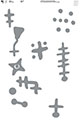
Studio Territorio Ticino is a coordinated set of activities, including design studios, in loco interventions, publications and other initiatives, that aims to offer a “transversal” reading of the territory. It starts from the geo-morphological dimension of Canton Ticino, referencing the complex altimetry that so profoundly affects its spatial perception. It is an Alpine area with mountains facing each other across a valley floor of changing breadths.
www.stt.arc.usi.ch
Founded in 2007, The Swiss Architectural Award is promoted since the 2019-2020 edition by the Teatro dell’architettura Foundation and organised by the USI-Accademia di architettura in Mendrisio. In the jury, chaired by Mario Botta, are represented the three Swiss schools of architecture of USI, EPFL and ETH. The award is aimed at recognizing and spotlighting architects from all over the world that, through their own work, have made a significant contribution to contemporary architecture by showing a peculiar sensitivity to the environment and at the same time encouraging public debate on the role of architecture in contemporary society. The prize amounts to 100,000 Swiss francs. Every 2 years, it is awarded to architects aged less than 50 who have realized at least 3 relevant works. The candidates are nominated to the jury by an international committee of advisors.
www.swissarchitecturalaward.com
The Teatro dell’architettura Foundation is at the origin of the Teatro dell’architettura of the Università della Svizzera italiana, a tool designed to fuel disciplinary debate, to strengthen the educational offerings of USI and the Academy of Architecture in particular, and to encourage a wider audience to become more aware of the crucial issues of contemporary architectural culture, the Teatro dell’architettura Foundation promotes since 2019 the Swiss Architectural Award.
www.fondazionetam.ch
The Association Amici dell’Accademia di architettura di Mendrisio (Friends of the Academy of Architecture of Mendrisio) was founded in 1996, at the same time as the foundation of the Academy of Architecture of the Università della Svizzera italiana. The aim of the association is to raise funds to create scholarships for deserving foreign students with financial difficulties and to support projects that contribute to the development of the faculty, with the intention of creating a fertile ground for discussion and debate, open and rich in stimuli thanks to the most diverse cultural and social realities.
www.amiciaccademia.ch
Books dear to me, chosen in bookstores about twenty years ago, with only the curiosity of the moment in mind.
primavera2020.ch
|
Perpetuare architettuta. Gli interventi di Martino Pedrozzi sul patrimonio rurale in Valle di Blenio e in Val Malvaglia 1994-2017
Ita-Eng, Park Books, Zürich 2020 |
|
|
Quindici anni di WISH, Workshop on International Social Housing
Mendrisio Academy Press, Mendrisio 2020 |
|
|
Mini Cigarillos. Due mesi nello studio di Oscar Niemeyer
Letteraventidue, Siracusa 2020 |
|
|
Cigarrilhas. Dois meses no escritório de Oscar Niemeyer
Portoghese, Romano Guerra Editora, São Paulo, 2022 |
|
|
Mini Cigarillos. Working with Oscar Niemeyer for two months
Inglese, Lars Müller Publishers, Zurigo, 2025 |
|
|
Casualità e disegno, Edilizia residenziale e spazio pubblico a Lugano
Edizioni Casagrande, Bellinzona 2020 |
|
|
Il lido di Ascona di Livio Vacchini, Una teoria del giunto
Edizioni Casagrande, Bellinzona 2017 |
| 1971 | Born in Zurich |
| 1974–1975 | Living in Peru |
| 1990–1996 | Studies at the EPFL with Frédéric Aubry, Patrick Mestelan, Luigi Snozzi, Vincent Mangeat and Kenneth Frampton Internships at Campi e Pessina, Tita Carloni and Livio Vacchini Diploma with Mario Botta |
| since 1997 | Independent architect |
| 1999 | Two months in Oscar Niemeyer office in Rio de Janeiro |
| since 2003 | Conception and direction of WISH, Università della Svizzera italiana, Academy of Architecture, Mendrisio |
| 2005–2021 | Lecturer, Università della Svizzera italiana, Academy of Architecture, Mendrisio |
| 2008 | Honorary doctor at Yerevan State University of Architecture and Construction, Armenia |
| since 2014 | Board member of the Fondazione Casa dell’Accademia |
| since 2015 | Board member of the Fondazione Teatro dell’Architettura |
| 2016–2020 | Visiting professor, Università della Svizzera italiana, Academy of Architecture, Mendrisio |
| since 2021 | Titular professor, Università della Svizzera italiana, Academy of Architecture, Mendrisio |
| since 2023 | President of the Associazione Amici dell’Accademia di architettura di Mendrisio |
| 2025–2026 | Diploma 2026 director, Università della Svizzera italiana, Academy of Architecture, Mendrisio |